
Hamilton County Probate Venue
Hamilton County uses Chancery Court and the Clerk and Master for probate-related records. The county sources reviewed did not show a separate Hamilton County probate court page. That distinction matters because a search for probate records may need Chancery Court terms, such as estate, trust, guardianship, conservatorship, will contest, or potential heirs. Chancery also handles broader equity matters, contracts, tax, liens, boundary disputes, fraud, election contests, and administrative review, so a probate-style file may sit beside other chancery records rather than in a stand-alone probate index.
The Clerk and Master is Rachael Kapperman. The office is listed at 300 Courthouse, 625 Georgia Avenue, Chattanooga, TN 37402, with phone 423-209-6600 and fax 423-209-6601. Hours in the research are 8:00 a.m. to 4:00 p.m. The Clerk and Master manages Chancery Court dockets and court documents and may also act as Master in Chancery for the Eleventh Judicial District. For probate records, that office is the practical starting point when a public portal, docket page, or form link does not answer the question.
The Hamilton County Court System page also links Clerk and Master forms, will contest forms, potential-heir materials, procedural steps, court rules and fees, public records policy, an open records request form, email filing, and public records access. Those local links show how Hamilton County Chancery Court routes probate work.
The Chancery Court docket page is the local source for dockets, public records links, and Clerk and Master contact details.
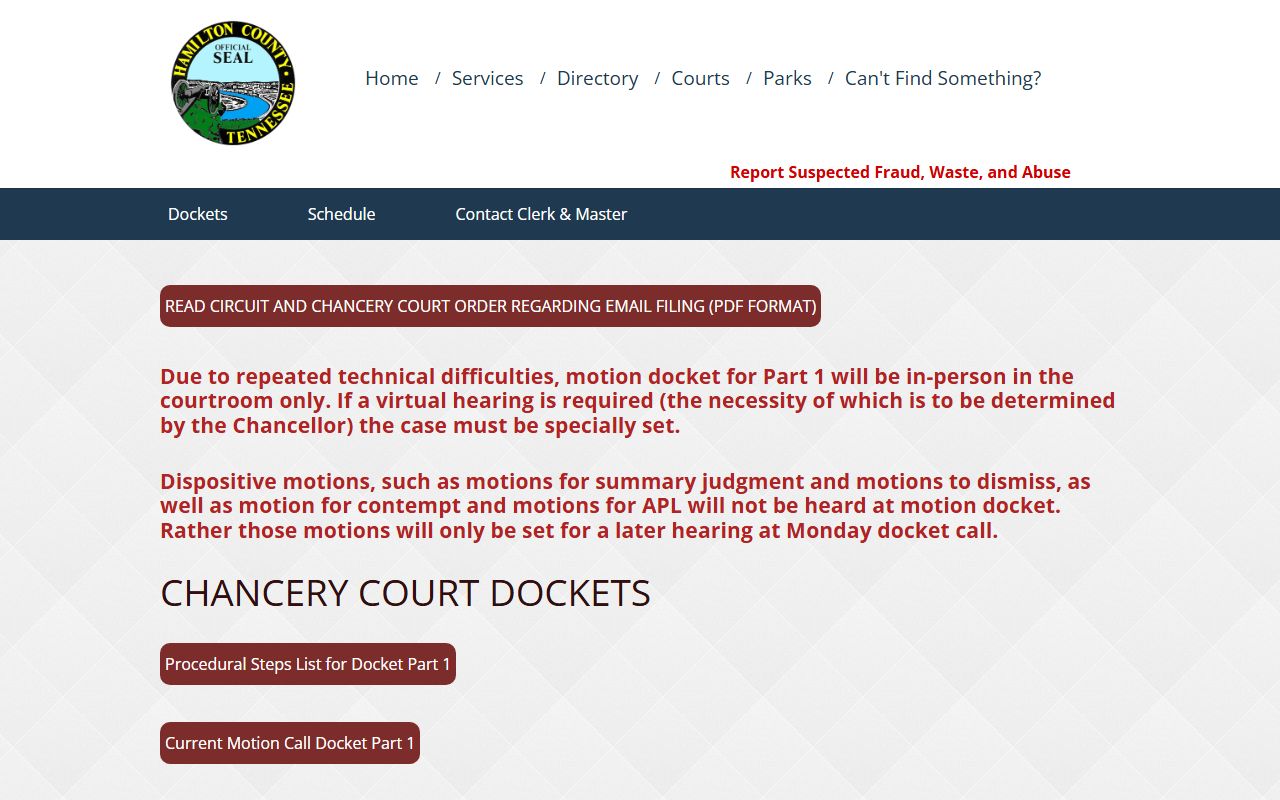
The Chancery source reflects why Hamilton County probate records should be traced through Chancery Court, including docket links, public records links, and Clerk and Master contact details.
Hamilton County Probate Terms
Probate records use terms that can be hard to match to search fields. In Hamilton County, the name of the record may not say "probate" at all. It may be an estate case, a trust matter, a conservatorship, a guardianship, a will contest, or a potential-heirs filing. Use these labels when asking the Clerk and Master to locate a file.
- Estate administration
- A Chancery Court matter for opening a decedent's estate, appointing a representative, handling claims, and distributing property.
- Will contest
- A dispute over a will, such as capacity, undue influence, execution, or competing wills. Hamilton County Chancery links will contest forms.
- Potential heirs
- A local Chancery form category used to identify people with a possible interest in an estate.
- Conservatorship
- A court-supervised authority for an adult who needs help with personal or financial decisions.
- Guardianship
- A court-supervised authority for a protected person, often involving a minor or another person whose interests require court oversight.
- Letters testamentary or administration
- Documents that show who has authority to act for an estate after appointment by the court.
Search Hamilton County Probate Records
Start with the Chancery docket and public records links, then move to the Clerk and Master if the record is older, sensitive, archived, or not visible online. The research notes a public records portal linked from the county court-system page at hamilton.tncrtinfo.com, but the captured source set could not safely inspect the exact portal. Treat that as an access channel to try, not as proof that every probate record can be viewed online.
- Decide whether the matter is an estate, will contest, trust, guardianship, or conservatorship. If the name of the decedent or protected person is known, write it exactly.
- Check the Chancery Court docket page and the county court-system page for current dockets, public records links, procedural steps, and Chancery forms.
- Use the Clerk and Master contact path for records not found online. Ask whether the file is active, archived, sealed, redacted, or held in records management.
- For copies, provide the case number if known, party or decedent name, filing date range, requested document type, and whether a certified copy is needed.
- For filing costs, call 423-209-6600 before relying on any online cost list because Hamilton County Chancery warns that listed costs are estimated and not real time.
Note: Docket information helps locate a case, but the court setting and original docket control over a web copy.
Hamilton County Probate Contact
Probate-related filings route to Chancery Court and the Clerk and Master. Do not send estate or guardianship requests to the Criminal Court Clerk or assume the County Clerk can issue probate copies. The County Clerk handles marriage records and county administrative records, while the Circuit Court Clerk handles Circuit and Sessions Civil records. Chancery is the local office named in the research for estates, trusts, guardianships, conservatorships, and will contest materials.
Chancery Court / Clerk and Master
Clerk and Master: Rachael Kapperman
300 Courthouse, 625 Georgia Avenue
Chattanooga, TN 37402
423-209-6600
Fax: 423-209-6601
8:00 a.m. to 4:00 p.m.
The downtown courthouse is at 625 Georgia Avenue, between 6th and 7th Streets and Walnut and Georgia Avenue. For records that cannot be found through the public links, ask the Clerk and Master whether the matter has a case number, whether a paper file must be pulled, and whether redaction or a court order is required before release.
Hamilton County Probate Costs
The research did not locate a full Hamilton County Chancery probate fee schedule that could be copied into a fixed table. It did locate the county warning to call the Chancery office for up-to-date court costs because listed costs are estimated and not real time. That warning should control probate filing and copy planning.
| Probate item | Cost guidance |
|---|---|
| Estate administration filing | Call Clerk and Master at 423-209-6600 for current cost. |
| Will contest filing | Use Chancery forms and call for current filing cost. |
| Guardianship or conservatorship filing | Call for current court cost before filing or mailing payment. |
| Plain or certified copies | Ask the Clerk and Master for the current copy and certification charge. |
| Email filing cost issue | Follow Chancery email filing protocol and confirm fees by phone. |
Hamilton County Probate Files
A Hamilton County probate-style file may show the decedent or protected person name, case number, filing date, case type, petitioner, personal representative, executor, administrator, guardian, conservator, attorney of record, bond amount, inventory due date, creditor notice, publication details, hearing dates, part assignment, and orders. Estate records may include a petition, a will, letters, inventories, accountings, creditor claims, orders approving payments, and a final settlement. Trust matters may include trustee petitions, accountings, beneficiary issues, and court orders.
Guardianship and conservatorship records require more care than a routine estate file. They can include financial account information, medical facts, minor information, and protected-person details. A public case may still have restricted documents or redacted copies. Tennessee law also gives context: estate administration is tied to Title 30, while guardianship and conservatorship are tied to Title 34. State statutes do not replace local filing rules, but they explain why these matters are handled with more structure than a basic civil copy request.
Note: If an online probate search fails, ask for Chancery records by case type instead of assuming no record exists.
Restricted Probate Records
Tennessee public records are generally open for inspection unless a statute makes a record confidential, but probate-related files are not all open in the same way. Estate administration is often public, yet financial identifiers may be removed. Guardianship, conservatorship, adoption-related, mental-health, and minor-related material can be limited. The public copy may be less complete than the court file.
For access questions, start with the Chancery public records policy and open records request form linked from the Chancery page. If the record involves a minor, medical material, sealed exhibits, or a protected person, contact the Clerk and Master before submitting a broad request. A caller should be ready to give the case number, name, relationship to the matter, document sought, and reason a certified copy is needed. When a clerk says a court order is required, the request must follow that court's procedure.
Public Record Search
Sponsored Results