
Hamilton County Court Dockets
A docket is a court schedule or event list. In Hamilton County, dockets can show the court, division, judge or part, party or defendant name, case or docket number, event type, hearing date, motion date, arraignment setting, bond entry, disposition date, or grand jury list. A docket helps a reader find the next event or recent case movement. It does not normally include every pleading, exhibit, order, sentencing document, or certified file copy.
That distinction is important because Hamilton County repeatedly warns that web dockets are informational. Additions and modifications may appear on the original court docket before they appear online. The safer workflow is to use web dockets to find the case, then confirm with the court or clerk when the date is urgent. For full filings, orders, and certified records, use the record channels described for Hamilton County court records.
| Feature | Docket | Full Case Record |
|---|---|---|
| Purpose | Tracks hearings, settings, lists, and case events. | Stores pleadings, orders, charges, judgments, sentences, and cost records. |
| Format | Calendar, PDF list, search result, or schedule page. | Clerk file, portal case entry, document packet, or certified copy. |
| Best use | Checking court dates and case movement. | Reading legal filings and proving the official record. |
| Limits | May lag and may omit late changes. | May require clerk request, fee, redaction, or authorization. |
Find Hamilton County Dockets Online
Start with the docket page for the court that controls the case. Civil warrants and lower civil disputes route to Sessions Civil. Circuit civil, domestic, adoption, name change, and appeals from lower courts route to Circuit Court. Misdemeanors, preliminary felony hearings, traffic offenses, bonds, and dispositions route to Sessions Criminal. Felony cases after indictment, presentment, information, or lower court appeal route to Criminal Court. Estates and equity cases route to Chancery Court.
- Open the county court page or the specific docket page for Circuit, Chancery, Sessions Civil, Sessions Criminal, Criminal Court, or Juvenile Court.
- Pick the docket type that matches the case, such as weekly docket, motion docket, trial docket, arraignment docket, seven-day docket, bond list, or grand jury list.
- Search within the document or page by case number, party name, defendant name, attorney name, or docket number.
- Compare the docket entry with the case portal when one exists, such as TN Case Finder or Court Case Display.
- Call the clerk if the appearance date, bond status, or disposition must be verified before action is taken.
The Sessions Civil docket page specifically tells users to use browser find to search by case or attorney, which makes it a practical model for a Hamilton County court docket search.
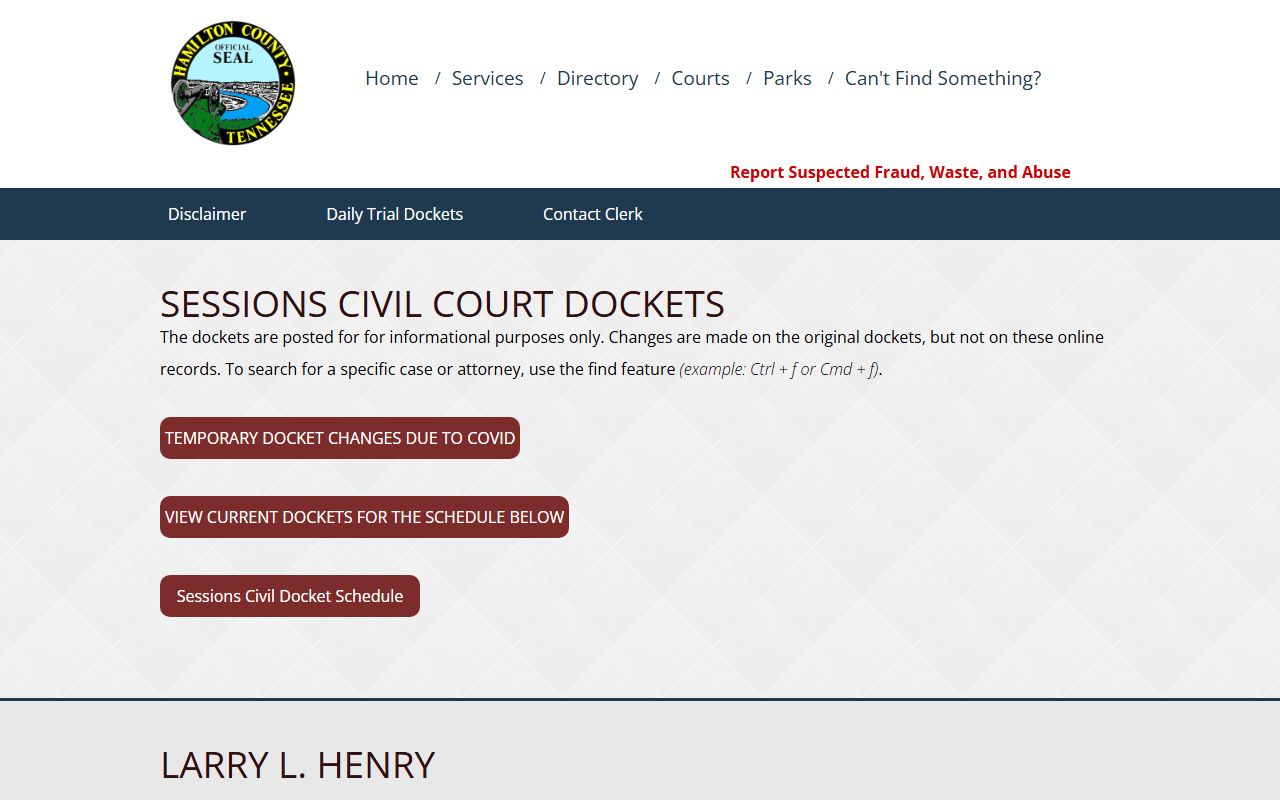
For Sessions Civil matters, keep the online docket date and the clerk contact together because the web page itself warns that the original docket controls.
Hamilton County Docket Entries
The research did not capture a live sample docket row, but the official docket pages and portal labels identify the fields a reader should expect to reconcile. Criminal and Sessions Criminal pages link dispositions, bonds, bond forfeitures, bond judgments, bondsman dockets, arresting-agency dockets, and court dates. Circuit Court divides schedules by division and motion docket. Chancery divides by Part 1 and Part 2, with motion dockets, calendar calls, and trial docket weeks.
| Field | What It Shows |
|---|---|
| Case or Docket Number | The identifier needed to match the schedule entry to the clerk's case file. |
| Court and Division | Which court, division, part, or judge controls the setting. |
| Party or Defendant | The names used to locate civil, criminal, traffic, chancery, or juvenile entries. |
| Event Type | Motion, arraignment, trial, scheduling, disposition, bond, grand jury, or procedural step. |
| Hearing Date | The date of the court event or the week covered by the docket. |
| Status or Disposition | Outcome information when the docket page publishes disposition and date data. |
Courts Publishing Hamilton County Dockets
Hamilton County publishes docket access across its local court structure. The channels are court-specific, so a person checking dockets should not assume a criminal setting will appear on a civil page or that a Chancery matter will appear in Court Case Display. Municipal courts for city citations are another separate layer when the citation was issued by a city court rather than the county system.
- Chancery Court posts Part 1 and Part 2 motion dockets, calendar calls, and trial docket weeks.
- Sessions Civil posts the current docket and current docket online search.
- Sessions Criminal posts current, seven-day, arresting-agency, bond, bondsman, and disposition links.
- Criminal Court posts trial, weekly, scheduling, arraignment, drug court, master, grand jury, bond, and disposition links.
- Circuit Court posts weekly division dockets, motion dockets, referee calendars, and procedural steps lists.
The Circuit Court docket page shows the separate division and motion-docket structure. That matters for Hamilton County court dockets because the division label can be as important as the case number.
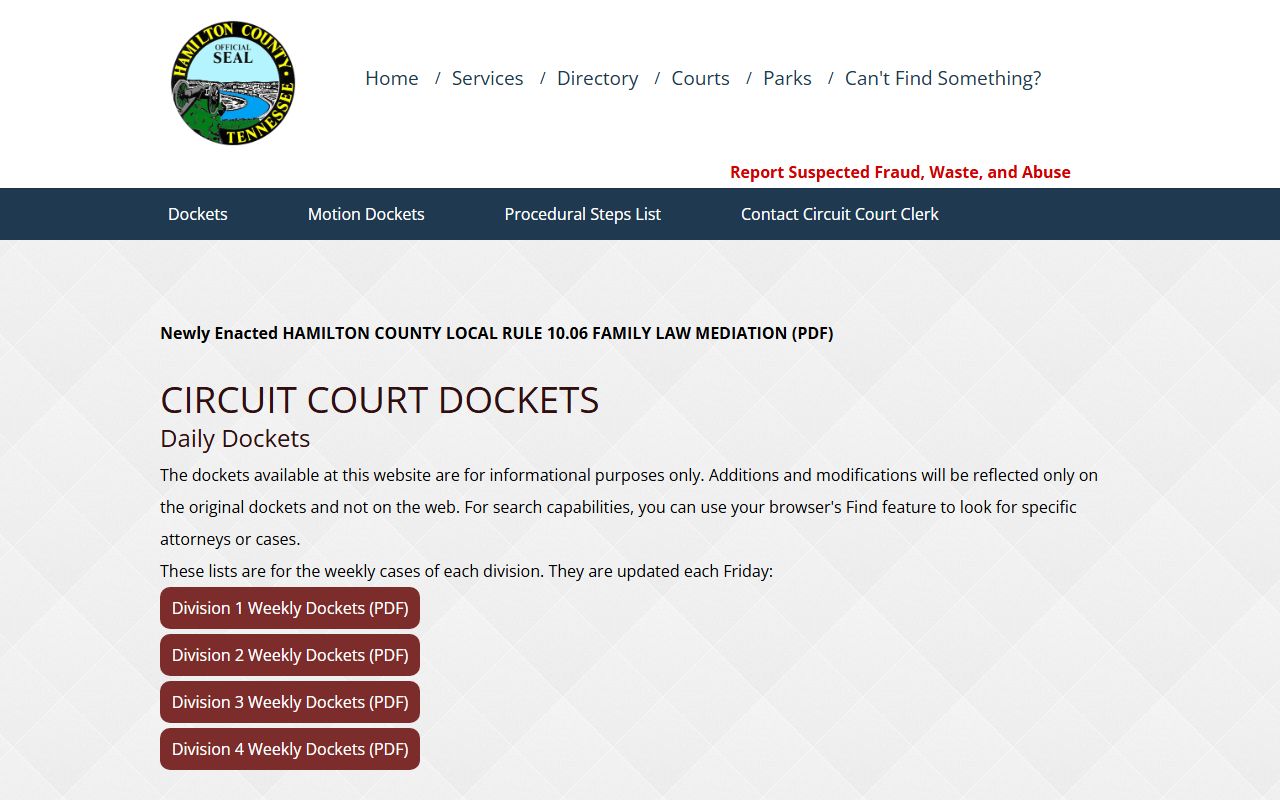
When a Circuit entry mentions a division, use that division when calling the Circuit Court Clerk at 423-209-6700.
Hamilton County Docket Update Timing
Update timing differs by court. Circuit Court says weekly division dockets and weekly motion dockets are updated each Friday. Criminal Court says dockets are updated every Thursday for the following week, and the weekly master docket is updated every Monday. Chancery Court's Part 1 motion docket is in person only unless the court determines a virtual hearing is necessary, while Part 2 motion docket is in person and via WebEx on the second and fourth Monday.
Sessions Civil warns that the web version is informational and may not reflect additions or modifications made to the original docket. Similar caution belongs on all Hamilton County court docket use. If a missed setting could lead to a capias, bond issue, judgment, default, or license problem, contact the court before relying only on the web version.
Note: Docket pages are useful for planning, but Hamilton County clerk confirmation controls urgent appearance questions.
Hamilton County Criminal Docket Clues
Criminal and Sessions Criminal dockets are especially detailed. Sessions Criminal links the arresting-agency docket, dispositions and dates, active bonds, bond forfeitures, bond judgments, and bondsman docket. Criminal Court links arraignment, weekly, scheduling, trial, drug court, master, grand jury true bill, no bill, dismissed, bond, and disposition lists. These lists help connect an arrest or charge to the next court step, but the complete criminal case file remains with the Criminal Court Clerk.
A grand jury true bill means an indictment was returned. A no bill means the grand jury did not return an indictment on that presentation. A dismissed list is not the same as a full expunction record. For the full case file, charges, pleas, disposition, sentence, and cost record, use Hamilton County criminal court records rather than only the docket.
- Arraignment
- A hearing where charges are read and a plea is entered.
- Disposition
- The outcome of a charge or case, such as guilty, dismissed, no bill, or not guilty.
- Bond Forfeiture
- A bond enforcement event after a missed appearance or bond violation.
- Capias
- A court arrest process often tied to failure to appear.
Hamilton County Juvenile Docket Limits
Hamilton County's court system links Juvenile Court dockets and the Juvenile Court Clerk, but juvenile case details are restricted under Tennessee law. Juvenile Court handles matters involving minors, including delinquency, status offenses, dependency and neglect, and child support-related matters. Public users should not expect the same open docket access available for adult civil and criminal matters.
The Juvenile Court Clerk is located at 1600 East Third Street, Chattanooga, TN 37404, and the directory lists 423-209-5250. The juvenile clerk access point is the correct fallback when a juvenile docket entry cannot be searched publicly.
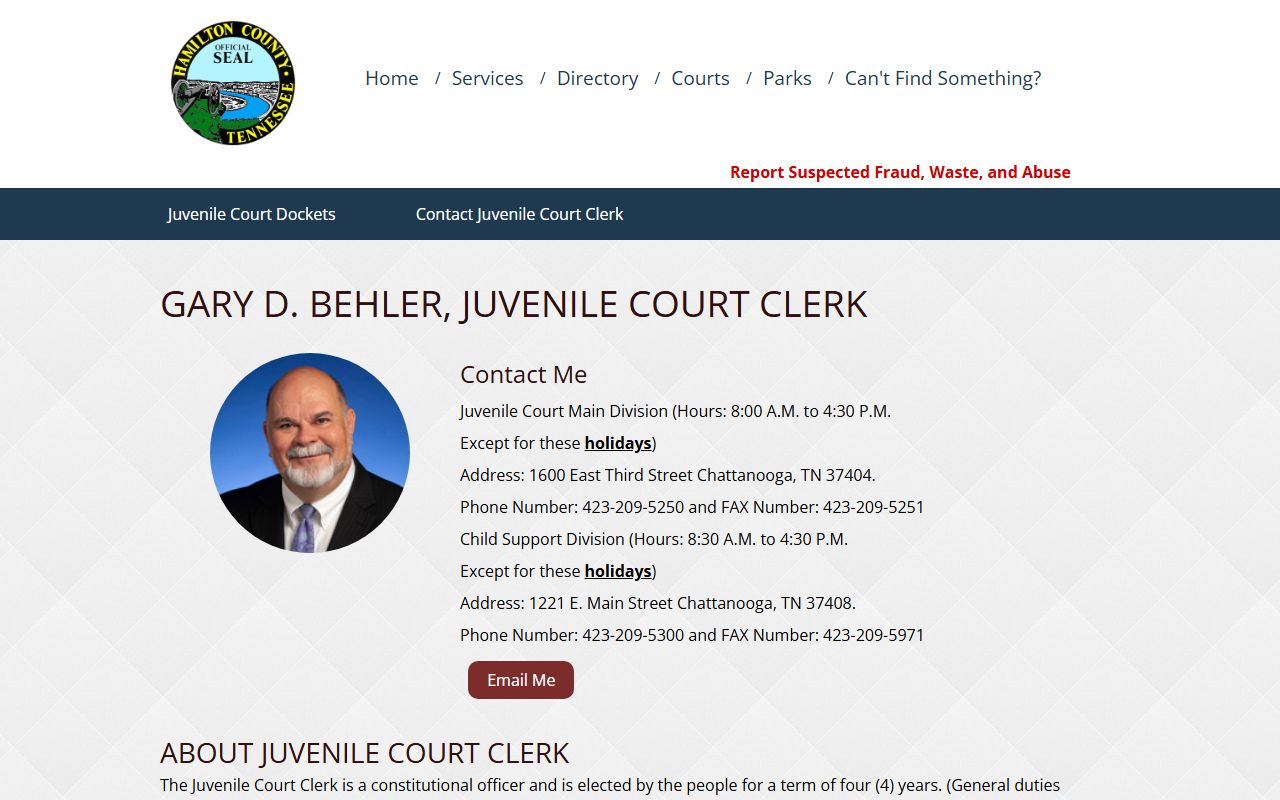
For juvenile matters, ask the clerk what proof of authority is required before seeking docket details or copies.